Rising maintenance costs
Aging hardware, support contracts, and emergency fixes consume budget without improving capability.

Search services, industries, resources, or company information.
Nexus Systems Group helps mid-sized organizations move legacy on-premise systems to secure, scalable cloud infrastructure through a structured migration approach designed to reduce risk, control costs, and protect business continuity.
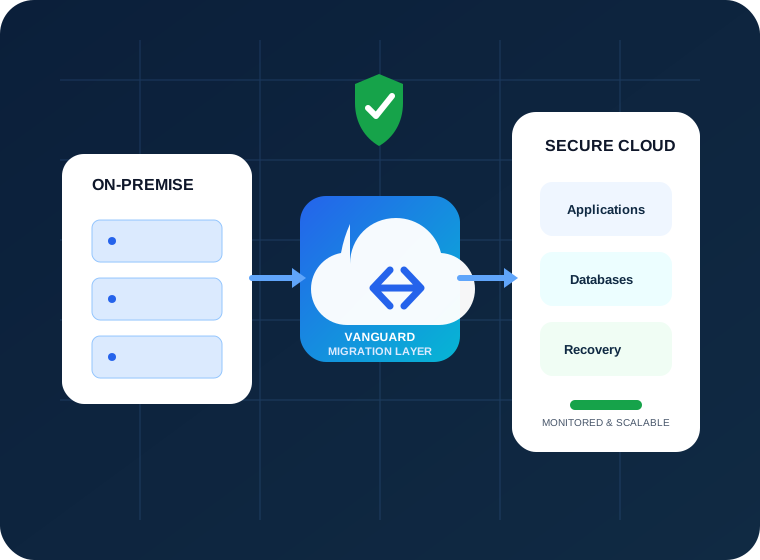
On-premise systems can remain valuable, but they become a constraint when cost, risk, performance, and operational complexity grow faster than the organization.
Aging hardware, support contracts, and emergency fixes consume budget without improving capability.
New locations, employees, and workloads are difficult to support without buying more hardware.
Unsupported systems and inconsistent access controls increase operational and security risk.
Backups may exist without tested recovery procedures, defined objectives, or resilient infrastructure.
Single points of failure and aging equipment can interrupt critical business operations.
Legacy network designs can make secure hybrid work slow, complex, or unreliable.
Infrastructure bottlenecks can reduce employee productivity and customer experience.
Leaders often lack clear information about infrastructure health, dependencies, and cost.
We connect technical decisions to business priorities, continuity requirements, security risk, and budget reality.
Move workloads with a controlled, business-aware plan.
Explore service →Build resilient cloud foundations for growth.
Explore service →Strengthen identities, networks, data, and monitoring.
Explore service →Improve visibility and remove avoidable cloud waste.
Explore service →Design tested recovery and continuity capabilities.
Explore service →Monitor, maintain, and continuously improve cloud estates.
Explore service →Improve legacy applications and databases pragmatically.
Explore service →Vanguard Cloud Architecture is a six-phase approach for understanding the current environment, choosing appropriate migration strategies, building secure foundations, and improving operations after cutover.
Explore the Vanguard FrameworkOur approach prioritizes clarity, security, low-disruption execution, documentation, and accountable handover.
Architecture begins with operational goals and constraints—not a preferred vendor.
Identity, network, data protection, monitoring, and recovery are integrated early.
Dependencies, pilots, rollback options, and cutover windows reduce avoidable operational risk.
Design choices include budgets, tagging, forecasting, and ongoing optimization.
Teams receive documentation, operating guidance, and practical handover.
Operations, monitoring, security review, and optimization continue after cutover.
Actual outcomes depend on the current environment, migration scope, operating model, and implementation decisions.
Clarify business goals, urgency, constraints, and decision criteria.
Document systems, applications, databases, dependencies, access, and cost.
Prioritize workloads, risks, migration strategies, and operating requirements.
Define target architecture, migration waves, security, recovery, and governance.
Validate assumptions with a controlled workload before scaling the approach.
Execute migration waves with testing, communication, and rollback planning.
Review performance, data, security controls, monitoring, and business acceptance.
Improve resource use, automation, cost management, and ongoing operations.
Explore common migration, security, continuity, and governance considerations.
Explore common migration, security, continuity, and governance considerations.
Explore common migration, security, continuity, and governance considerations.
Explore common migration, security, continuity, and governance considerations.
Explore common migration, security, continuity, and governance considerations.
Explore common migration, security, continuity, and governance considerations.
These scenarios illustrate delivery patterns only. They are not presented as real client engagements.
Aging servers, weak remote access, and inconsistent backup processes.
View scenario →Seasonal demand, inventory reliability, and limited infrastructure scalability.
View scenario →Legacy dependencies, continuity needs, and security-control modernization.
View scenario →Speak with Nexus Systems Group about a secure and practical path to modern cloud infrastructure.